India’s ecommerce market is unlike anywhere else in the world. While sellers in the US or UK can build a sustainable business on Amazon alone, Indian sellers face a fundamentally different reality: your customers are split across Amazon, Flipkart, Meesho, Myntra, Nykaa, and a dozen other platforms, each with its own buyer demographic, pricing expectation, and seller rules.
This is why multichannel selling isn’t optional for serious Indian sellers. It’s the baseline.
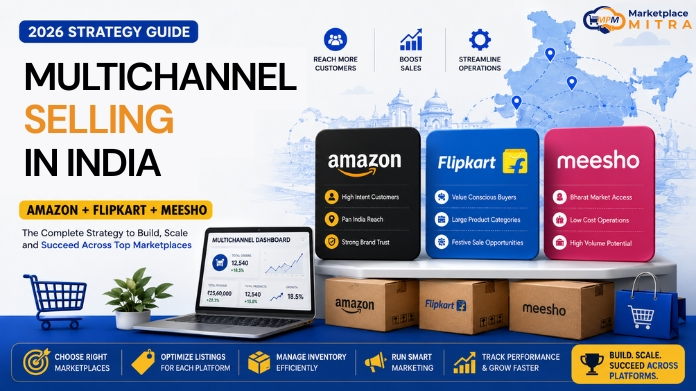
In this guide, you’ll learn exactly what multichannel selling means, why multi-channel retailing works differently in India, and how to build a practical strategy across Amazon, Flipkart, and Meesho, the three platforms that together account for the majority of Indian ecommerce volume.
What Is Multichannel Selling?
Multichannel selling is the practice of selling your products across more than one online sales channel simultaneously, including marketplaces, your own website, social commerce, or any combination of these.
Instead of putting all your revenue in one basket (say, only Amazon), you list and fulfil orders across multiple platforms at the same time, reaching different buyer segments with the same product catalogue.
What Is Multi Channel Retailing?
Multi channel retailing is the broader retail strategy behind this: the deliberate decision to meet customers wherever they shop, rather than expecting them to come to a single storefront. In ecommerce, this means your products appear on every platform your potential customer might visit.
For Indian sellers, multi channel retailing typically means being present on:
- Amazon India: premium and metro buyers, trust-driven
- Flipkart: tier-2 and tier-3 cities, value-conscious buyers
- Meesho: price-sensitive buyers, reseller network, deep rural reach
- Myntra / Nykaa: fashion and beauty category specialists
- Your own D2C website: brand-building and margin retention
What Is Multichannel in Simple Terms?
If someone searches “what is multichannel” without ecommerce context, the simplest answer is: selling through multiple channels instead of just one. In retail, a channel is any place where a transaction happens, such as a marketplace, a website, a physical store, or even a WhatsApp catalogue.
Multi channel selling means all of these work together, powered by the same inventory and product catalogue.
Why Multichannel Selling Matters for Indian Sellers in 2026
India’s ecommerce is projected to reach $300 billion by 2030. But that growth isn’t concentrated on one platform. Here’s why being on multiple channels isn’t just a growth strategy; it’s a risk management strategy too.
1. Your Buyers Are Not on Just One Platform
A 35-year-old working professional in Bengaluru buys electronics on Amazon Prime. Her mother in Kanpur buys sarees on Meesho. Her college-going daughter shops fashion exclusively on Myntra. These are three buyers for the same category and they’ll never overlap platforms.
If you’re only on Amazon, you’re invisible to two of those three buyers.
2. Each Marketplace Has a Different Price Ceiling
Meesho buyers expect aggressive pricing. Myntra buyers will pay a premium for the same product if it’s presented correctly. Flipkart sits somewhere in between. Multi channel selling lets you price strategically per platform rather than racing to the bottom on just one.
3. Algorithm Dependence Is a Business Risk
If your entire revenue depends on one marketplace’s algorithm, a single policy change, a bad review week, or a platform fee increase can damage your business significantly. Spreading across multiple channels gives you a buffer: when one channel dips, others compensate.
4. Meesho’s Reseller Network Is Unmatched
Meesho’s model is unique globally; it powers millions of resellers across small towns and villages. A single successful listing on Meesho can get amplified by thousands of resellers to buyers your other channels will never reach. You cannot replicate this reach through Amazon or Flipkart.
The Three-Platform Playbook: Amazon + Flipkart + Meesho
Most Indian sellers starting multichannel selling begin with these three. Here’s how to think about each one strategically.
Amazon India: The Trust Platform
Buyer profile: Urban, metro, premium, Prime subscribers
Wins on: Product quality, brand trust, faster delivery
Category leaders: Electronics, books, home appliances, premium fashion
Strategy tips:
- Invest in A+ content and Brand Registry if you’re a brand
- Price at or above Flipkart; Amazon buyers are less price-sensitive
- Focus on winning the Buy Box through FBA (Fulfilled by Amazon) where margins allow
- Use Amazon Ads aggressively for new listings; organic rank takes time
What to watch: Amazon’s commission structure and return rates are higher than Meesho. Factor this into your pricing model per SKU.
Flipkart: The Volume Platform
Buyer profile: Tier-2, tier-3 cities, value buyers, mobile-first shoppers
Wins on: Price competitiveness, regional reach, fashion & electronics volume
Category leaders: Smartphones, fashion, appliances, FMCG
Strategy tips:
- Price aggressively; Flipkart buyers compare before purchasing
- Use Flipkart Assured badge to improve trust and conversion
- Flipkart’s fashion category (via Myntra integration) is enormous; leverage it if you sell apparel
- Monitor Flipkart’s Smart Fulfilment options to reduce shipping costs
What to watch: Flipkart’s seller panel (Seller Hub) has its own quirks. Settlement cycles and return policies differ from Amazon and need separate reconciliation.
Meesho: The Reach Platform
Buyer profile: Price-sensitive buyers, small-town India, reseller network
Wins on: Volume, reach into rural markets, zero commission model (for some categories)
Category leaders: Fashion, home décor, accessories, ethnic wear
Strategy tips:
- List your lower-price-point products here; Meesho buyers are highly price sensitive
- Product images matter enormously; Meesho’s resellers will share your listing images directly with end buyers
- Keep your catalogue broad; Meesho’s algorithm rewards sellers with large SKU counts
- Fulfil fast; Meesho’s supplier ratings drop quickly with delayed shipments
What to watch: Meesho’s supplier panel is entirely separate from Amazon and Flipkart. Without multichannel selling software, your team will need to log into it independently to manage orders and inventory.
The Biggest Operational Challenge: Inventory Across Multiple Channels
Here’s the problem nobody warns you about when you start multi channel selling: one pool of inventory, three platforms pulling from it simultaneously.
Say you have 10 units of a cotton kurti in size M. You list all 10 on Amazon, Flipkart, and Meesho. Three customers buy at the same moment, one from each platform. You can only fulfil one of them. The other two become cancellations, hurting your seller ratings on both platforms.
This is called overselling, and it’s the most expensive operational failure in multichannel retailing.
How Real-Time Inventory Sync Solves This
The solution is a centralised inventory system that reduces your available stock count across all platforms the moment any single unit sells, on any channel.
When that kurti sells on Meesho, your Amazon and Flipkart listings should show 9 units within seconds, not hours. This requires multichannel selling software with a real-time sync engine, not spreadsheets or manual updates.
Sellers using proper multichannel inventory management report up to 69% fewer inventory mismatch incidents compared to manual methods.
GST and Compliance Across Multiple Channels
Every order across every channel in India requires a GST-compliant invoice. This becomes significantly more complex when you’re selling on three or more platforms simultaneously.
What Multichannel GST Compliance Requires
- Separate invoice per order: each Amazon, Flipkart, and Meesho order needs its own GST invoice
- Forward charge vs. reverse charge: the mechanism differs by marketplace and order type
- GSTIN validation: especially important for B2B orders
- e-Way bills: mandatory for orders above ₹50,000 in value
- TDS reconciliation: each marketplace deducts TDS at different rates
Doing this manually across three channels, for hundreds of orders a day, is where most growing sellers start making costly errors, or start spending 3 to 5 hours a week on compliance alone.
Payment Reconciliation: The Hidden Complexity of Multi Channel Selling
Each marketplace pays you on a different cycle, with different commission slabs, different return deductions, and different TDS structures. Meesho pays weekly. Flipkart pays bi-weekly. Amazon has its own settlement schedule with variable return adjustments.
Without a system that auto-matches settlements to individual orders, you will miss discrepancies. Most Indian multichannel sellers who switch to automated reconciliation discover unrecovered payouts within their first week of proper tracking.
Setting Up Your Multichannel Selling Operation: Step by Step
Step 1: Audit Your Catalogue for Channel Fit
Not every product belongs on every channel. Before listing everywhere, map your catalogue:
- High-margin, branded products → Amazon (A+ content, Brand Registry)
- Volume SKUs, price-competitive products → Flipkart
- Entry-level, price-sensitive, high-volume SKUs → Meesho
- Fashion and lifestyle → Myntra in addition to the above
Step 2: Set Channel-Specific Pricing
Your selling price needs to account for different commission structures per platform. A ₹499 product might be profitable on Meesho (low commission) but break-even on Amazon (higher commission + FBA fees). Build a per-channel pricing model before you list.
Step 3: Create a Centralised Inventory Buffer
Don’t list your full stock on every channel. Keep a buffer: list 80% of your available units across channels and hold 20% as a safety stock. This gives you room to absorb simultaneous orders before your sync engine catches up.
Step 4: Set Up Multichannel Selling Software
At small volumes (under 50 orders/day), manual management is painful but possible. Beyond that, you need a centralised system that handles:
- Unified order inbox (all channels in one place)
- Real-time inventory sync across all platforms
- Automated GST invoicing per order
- Payment reconciliation per channel
- WhatsApp alerts for new orders and low stock
This is where a purpose-built multi channel ecommerce platform for Indian sellers becomes essential, not a nice-to-have.
Step 5: Standardise Your Fulfilment Process
With orders coming from three different channels simultaneously, your warehouse team needs a single, consistent pick-pack-ship process regardless of which platform the order came from. Use courier integrations (Delhivery, Blue Dart, XpressBees) that generate AWBs from one system.
Step 6: Monitor Channel Performance Weekly
Track, per channel:
- Orders volume
- Cancellation rate
- Return rate
- Average order value
- Net revenue after commissions and returns
This tells you where to invest more (better listings, more SKUs) and where to pull back if a channel becomes unprofitable for a category.
Common Mistakes Indian Sellers Make in Multichannel Selling
Listing the same price everywhere: Meesho buyers and Amazon Prime buyers have completely different price expectations. Flat pricing across channels either leaves money on the table or kills conversion on price-sensitive platforms.
Managing inventory manually in spreadsheets: Works for 20 orders a day. Falls apart at 100. By the time you’ve updated Meesho’s stock manually, Amazon may have already oversold the same units.
Ignoring seller ratings per platform: Your Flipkart seller rating and your Amazon seller rating are independent. A bad month on one doesn’t affect the other, but a bad month on both (from operational chaos) can get your listings suppressed on multiple channels simultaneously.
Treating returns as an afterthought: Return policies differ by platform. Meesho’s return window, Flipkart’s return process, and Amazon’s A-to-Z guarantee are entirely different. Your return profile per channel needs to be configured and reconciled separately.
Not building towards D2C: Marketplaces take 15 to 30% of every sale in commissions. As you scale, building your own Shopify or WooCommerce store alongside your marketplace presence protects your margins and builds a customer base you actually own.
When to Add More Channels Beyond the Core Three
Once Amazon + Flipkart + Meesho are running smoothly with proper multichannel infrastructure, consider adding:
- Myntra / Nykaa: if you sell fashion, beauty, or lifestyle
- JioMart / AJIO: growing fast in tier-2 and tier-3 cities
- Shopify / WooCommerce: D2C for margin and brand control
- Amazon Global / eBay: international expansion when ready
The rule: don’t add a new channel until your existing channels are operationally stable. Adding Myntra when your Meesho inventory is still managed in a spreadsheet will accelerate chaos, not growth.
Conclusion: Multichannel Selling Is India’s Ecommerce Reality
Multi channel retailing isn’t a growth hack for Indian sellers; it’s the minimum viable operating model for anyone who wants to build a sustainable ecommerce business in India. Your buyers are spread across platforms. Your competitors are already on all of them. The question isn’t whether to sell across multiple channels, but how to do it without the operational chaos that kills margins and seller ratings.
The answer is simple in principle: one centralised system that manages orders, inventory, GST invoicing, payments, and logistics across every channel you sell on, so your team works from one place instead of five.
Ready to manage Amazon, Flipkart, and Meesho from a single dashboard? See how Marketplace Mitra’s multi-channel ecommerce platform gives Indian sellers complete control over every channel, with real-time inventory sync, automated GST invoicing, and WhatsApp alerts built in.
Start your 30-day free trial → No credit card required.